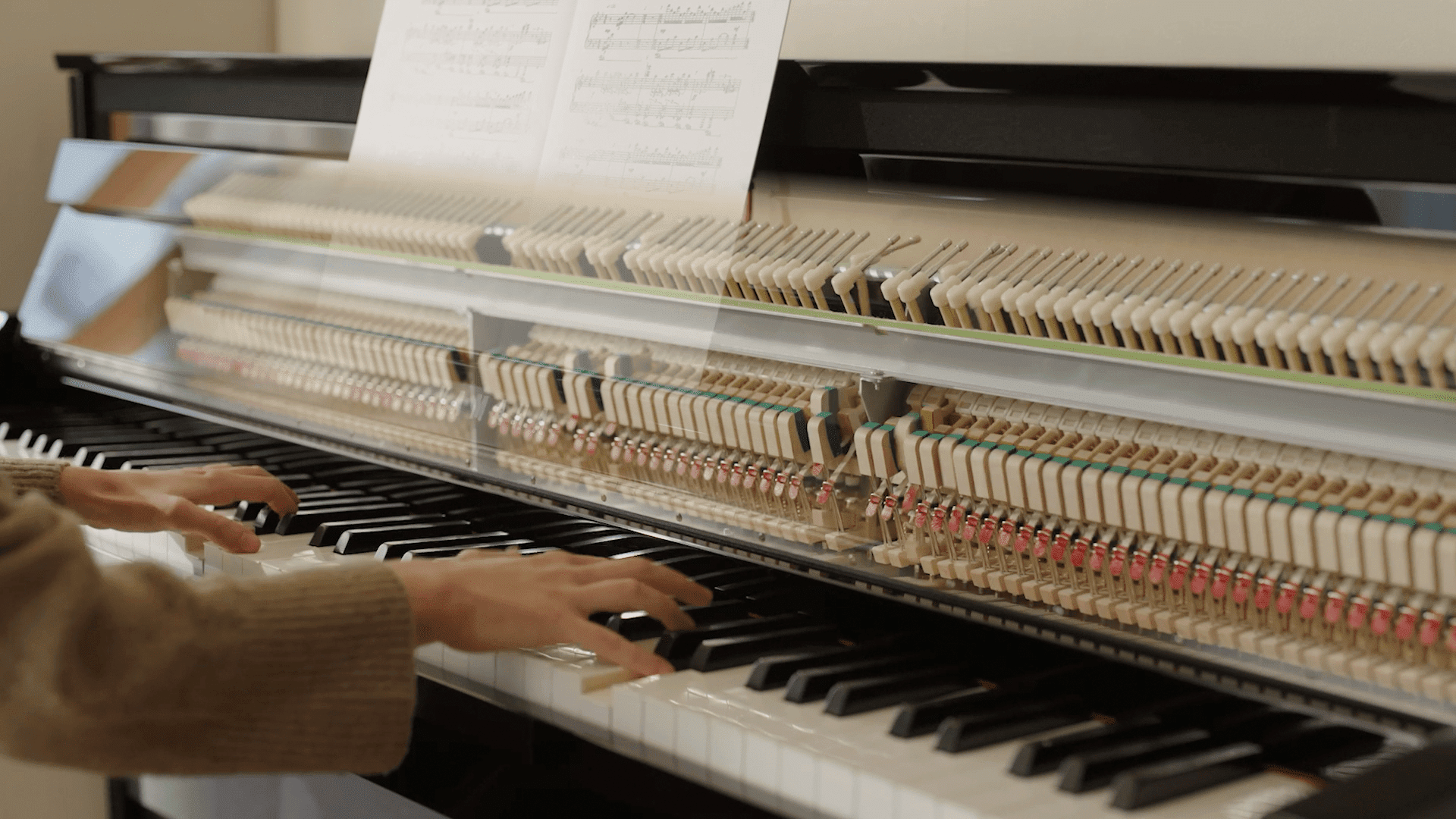
piano-naha.com – Most people don’t fall in love with a piano because of a spec sheet. They fall in love because the keys fight back in the right way, the pedals behave like they should, and the sound makes you stop thinking about speakers. The Yamaha NU1XA sits right in that territory: it’s built for players who want an acoustic-like experience at home, but with modern advantages—especially quiet practice and consistency.
In Yamaha’s own framing, the NU1XA belongs to the Yamaha AvantGrand (often searched as Yamaha Avant Grand or Avantgrand) family of “hybrid” pianos—models designed to combine real acoustic action mechanisms with digital tone generation.
What “AvantGrand” Means in Plain Terms
“Hybrid” can sound vague, so here’s the simplest meaning: the action (the physical mechanism your fingers interact with) is closer to an acoustic piano than a typical digital. Yamaha’s AvantGrand line includes models that use grand actions (like N1X/N2/N3X) and models that use upright actions for a more compact cabinet—where the NU1XA sits.
That distinction matters because grand and upright actions feel different—especially in repeated notes and fast control near the key surface. Some players prefer the nimble feel of an upright action; others chase the repetition feel of a grand. The NU1XA is intentionally in the “upright-action realism, smaller footprint” lane.
The Core of the NU1XA: Action + Sensors
A big part of why the nu1xa is talked about as more than a cosmetic refresh is Yamaha’s sensor approach. On the official NU1XA product page, Yamaha highlights an Articulation Sensor System that uses sensors on both keys and hammers—aimed at capturing more nuanced movement information than key-only tracking.
In real playing terms, better sensing typically shows up as:
-
more consistent soft-to-loud control
-
cleaner repetition recognition
-
fewer “surprise” dynamics when you’re playing gently
That doesn’t automatically make it “better for everyone,” but it does explain why NU1XA discussions focus heavily on feel and control, not just sound.
Sound: CFX, Bösendorfer, and Why Headphones Matter
Yamaha positions the NU1XA around two flagship concert grand voices: Yamaha CFX and Bösendorfer Imperial samples.
Where it gets especially practical is headphone practice. Yamaha notes binaural sampling for these voices on NU1XA—intended to make headphone sound feel more spatial and less “inside your head.”
If you practice late at night, that one feature can change your relationship with the instrument. Headphone tone that feels natural tends to keep you practicing longer, because it’s less fatiguing.
Resonance and Expression Modeling: The “Body” of the Sound
Digital pianos often fail not because the raw sample is bad, but because everything between notes feels too clean. Yamaha lists Virtual Resonance Modeling (VRM) and Grand Expression Modeling for the NU1XA—features aimed at recreating the resonant complexity and response behavior you expect from acoustic instruments.
You can think of these as attempts to restore “messy realism”:
-
pedal-down resonance that blooms instead of staying flat
-
a sense that tone reacts to touch, not just volume
It’s still a digital engine, but the goal is the same: reduce the feeling that sound is coming from a fixed point and increase the illusion that it’s coming from a vibrating instrument.
Pedals, Cabinet, and Everyday Use
The NU1XA is marketed as compact within the AvantGrand lineup, but Yamaha also emphasizes “grand piano”-inspired experience and refined design.
Retail listings and Yamaha materials commonly call out GrandTouch pedals and a “new sound system,” plus Bluetooth connectivity for device/app integration.
The practical point: this isn’t meant to be a “feature toy.” It’s meant to live in a home like an upright—played often, used quietly when needed, and stable across seasons.
Where NU1XA Sits Compared to NU1X
If you’re researching, you’ll probably run into the NU1X because it’s the direct predecessor. Yamaha’s own timeline (also echoed in general references) places NU1 → NU1X → NU1XA as the evolution of the AvantGrand upright hybrid line, with the NU1XA announced in 2023.
The safest way to compare isn’t to hunt a single “best” bullet point. Instead, compare:
-
action feel (especially repetition and soft control)
-
headphone experience (binaural vs standard)
-
interface and connectivity (how you actually use it daily)
One Small Player Insight People Miss
When you test an instrument, don’t start with loud, impressive chords. Start with quiet playing: slow scales, soft repeated notes, and simple voicing in the middle register. If a piano feels responsive at low volume and low intensity, it usually holds up when you push it.
Many instruments can sound big when you hit them hard. Fewer feel trustworthy when you’re trying to control a whisper.
A Quick, Human Aside
After a long practice session, musicians unwind in odd little ways—tea, a walk, or something silly at the table. Some people even pull out party decks with joke titles like go fun yourself card game. It’s not deep; it’s just a pressure release after concentrating on details for an hour.
The Yamaha NU1XA is best understood as an upright-action member of the Yamaha AvantGrand line that leans hard into two things: acoustic-like control (through action and sensing) and a more convincing listening experience (especially on headphones).
If you’re comparing options, judge it the way you’ll live with it: quiet practice, repetition feel, and whether it makes you want to sit down and play again tomorrow.